
Blog
Google Ads campaigns for leads that actually sell

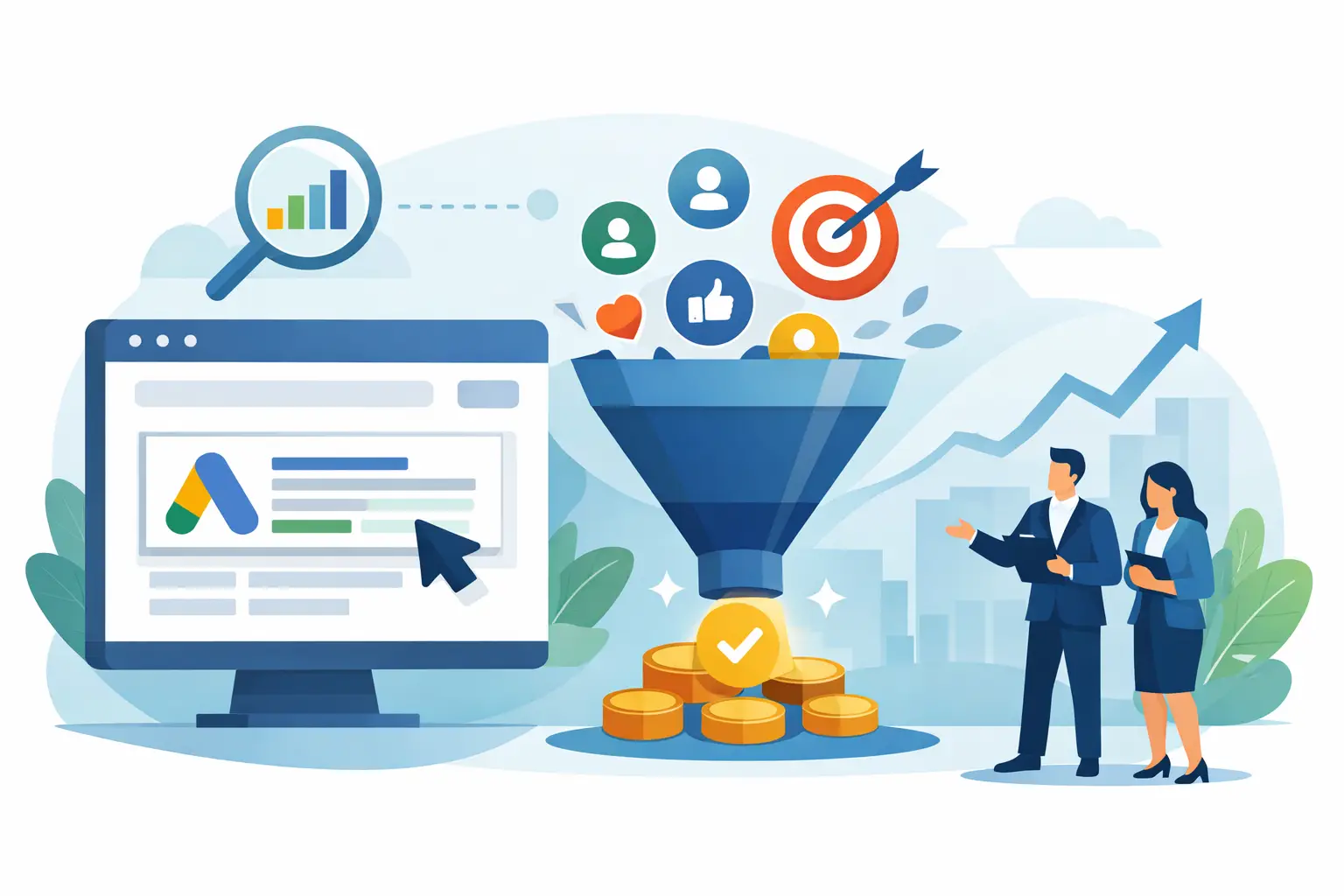
Some campaigns generate forms. And some campaigns generate real sales opportunities. The difference usually isn't in the budget, but in how Google Ads campaigns for leads are designed from the first click to sales follow-up.
Many companies invest in Google Ads expecting “more leads” and end up receiving unhelpful inquiries, leads with no buying intent, or an excessively high cost per opportunity. The problem isn't the platform. The problem is treating lead generation as if it only depends on activating ads and waiting for results.
When a campaign is well-planned, Google Ads can become a predictable channel for feeding the sales team with quality demand. However, to achieve this, strategy, search intent, bids, landing pages, measurement, and sales process must be aligned. If one piece fails, performance suffers.
What makes Google Ads campaigns profitable for leads
Profitability in lead generation isn't measured by the raw number of conversions. It's measured by how many of those registrations advance through the funnel and end up generating business. A low cost per lead might seem like a win, but if those contacts don't respond, don't qualify, or don't buy, the campaign is masking the problem.
Therefore, a lead-oriented account should be built around a central question: what type of prospect does the company really need? It's not the same to capture people asking for general information as it is to attract users with a clear need, budget, and urgency. Nor is it the same to sell a low-ticket service as a consultative solution with a long sales cycle.
Here's an important nuance: not all searches with volume have commercial value. Often, broader keywords bring in cheap but less qualified traffic. In contrast, more specific terms usually generate fewer conversions in volume, but with much higher quality. For leads, that difference weighs much more than a simple CTR.
Search intent rules
If a company wants results, it must understand that Google Ads captures existing demand. This means that user intent matters more than the most creative ad. A person searching for “accounting software for small and medium-sized businesses” is closer to making a decision than someone searching for “what is digital accounting.” Both searches can be useful, but they shouldn't be treated the same.
In lead generation campaigns, it's advisable to clearly separate informational, comparative, and transactional searches. The first can be useful in certain sectors if there's a subsequent nurturing strategy. The second often works well for brands competing in mature markets. Transactional searches, on the other hand, tend to offer more direct conversion, although they are also more competitive.
The key is not to mix everything into the same group and expect the algorithm to figure it out on its own. Google automates many tasks, yes, but it still needs clear signals. The more precise the structure, the better it can optimize.
How to structure a campaign to get quality leads
A good structure starts by segmenting services, problems, or lines of business. If a company offers multiple services, it's not advisable to put everything into the same campaign with generic ads. Each solution has different searches, objections, and messages.
Then, the ad must continue to precisely match the user's intent. If someone is looking for a concrete solution, they don't want to land on a corporate page full of generic text. They want to confirm in seconds that they're in the right place, understand the value proposition, and know what to do next.
The landing page, at this point, is not an add-on. It's part of campaign performance. If the page loads slowly, asks for too much information, or doesn't convey trust, the cost per lead will increase even if the ad setup is correct. And if it converts a lot but with low quality, then the problem might be with the promise, the form, or the lack of filters.
One detail that many companies overlook is the balance between volume and friction. The fewer fields a form has, the more conversions it usually generates. But that doesn't always mean better opportunities. In some cases, asking for additional information helps to qualify better. It depends on the service, the average ticket price, and the business's sales capacity.
The error of optimizing only for forms
One of the most frequent failures in lead generation campaigns is to optimize solely for the initial conversion. The system learns to get forms, calls, or messages, but not necessarily to find valuable leads.
If the company does not return information about which leads were valid, which progressed, and which ended up closing, Google optimizes with a partial view. This limits performance in the medium term. The algorithm works better when it receives business signals, not just marketing signals.
That's why mature measurement connects the campaign to the CRM or at least to a constant commercial review. It's not just about knowing how many leads came in, but about understanding their quality by source, keyword, device, location, and message. That's where decisions that truly improve returns begin.
In competitive sectors, this difference is critical. Two companies can invest the same amount and generate a similar volume of leads, but the one that calibrates the quality of its leads usually ends up paying less for each closed sale.
Google Ads Campaigns for Leads: Search, Display, and Remarketing
When discussing Google Ads campaigns for leads, the Search Network is usually the most logical starting point. It captures users with active intent and allows for high control over keywords, ads, and landing pages. For many businesses, it remains the primary channel for generating business opportunities with clear intent.
Now, searching isn't always enough. In some sectors, the user needs more time to decide. That's where remarketing can reinforce conversion, remind the prospect of the offer, and recover visits that didn't complete the form in the first session.
Display, for its part, requires more care. It can help gain visibility or support consideration campaigns, but if used without precise targeting, it often attracts less qualified traffic. It is not a bad format by definition. It simply demands different objectives and a more strategic approach.
There are also cases where Performance Max can deliver interesting volume, though it doesn't always offer the level of control needed for a lead quality-focused strategy. It works best when the account already has solid data, well-developed assets, and finely tuned measurement. Otherwise, it can generate conversions that are difficult to interpret.
The Role of Supply in Conversion
Many campaigns fail not because of the ad or the targeting, but because of the offer. If the user doesn't perceive a clear reason to provide their data, conversion drops. And if the offer is too generic, it will attract curious people rather than potential buyers.
A good offer doesn't always mean a discount. Sometimes a consultation, demonstration, audit, or initial valuation works better. The important thing is that it connects with the user's decision-making moment and the real value of the service.
Here too, it's advisable to avoid inflated messages. Over-promising can improve CTR and worsen lead quality. Instead, a clear, specific, and realistic approach usually filters better and prepares for a more productive sales conversation.
What separates a good campaign from a lead generation system
An isolated campaign can work for a few weeks. A well-designed lead generation system sustains results and allows for more controlled scaling. That difference appears when advertising, the website, sales tracking, and automation work in the same direction.
If a lead comes in and takes hours to get a response, value is lost. If there are no qualification criteria, the sales team wastes time on cold contacts. If there's no nurturing process, many opportunities go cold unnecessarily. That's why lead campaigns shouldn't be analyzed as isolated actions, but as part of the complete acquisition process.
That's where a comprehensive approach proves advantageous. When the advertising strategy connects with optimized landing pages, automation, CRM, and quality analytics, the investment is no longer solely reliant on intuition. It becomes a more measurable and scalable business operation. This is precisely the kind of approach companies like CLICK Digital adopt when aiming not just to attract leads, but to convert them into real growth.
If your company is already investing in Google Ads, but leads aren't converting into sales, you probably don't need more traffic. You need a better-tuned system. Because in digital lead generation, growth isn't about receiving more forms, but about generating better business conversations.
