
Blog
Google Ads or Meta Ads: which is better

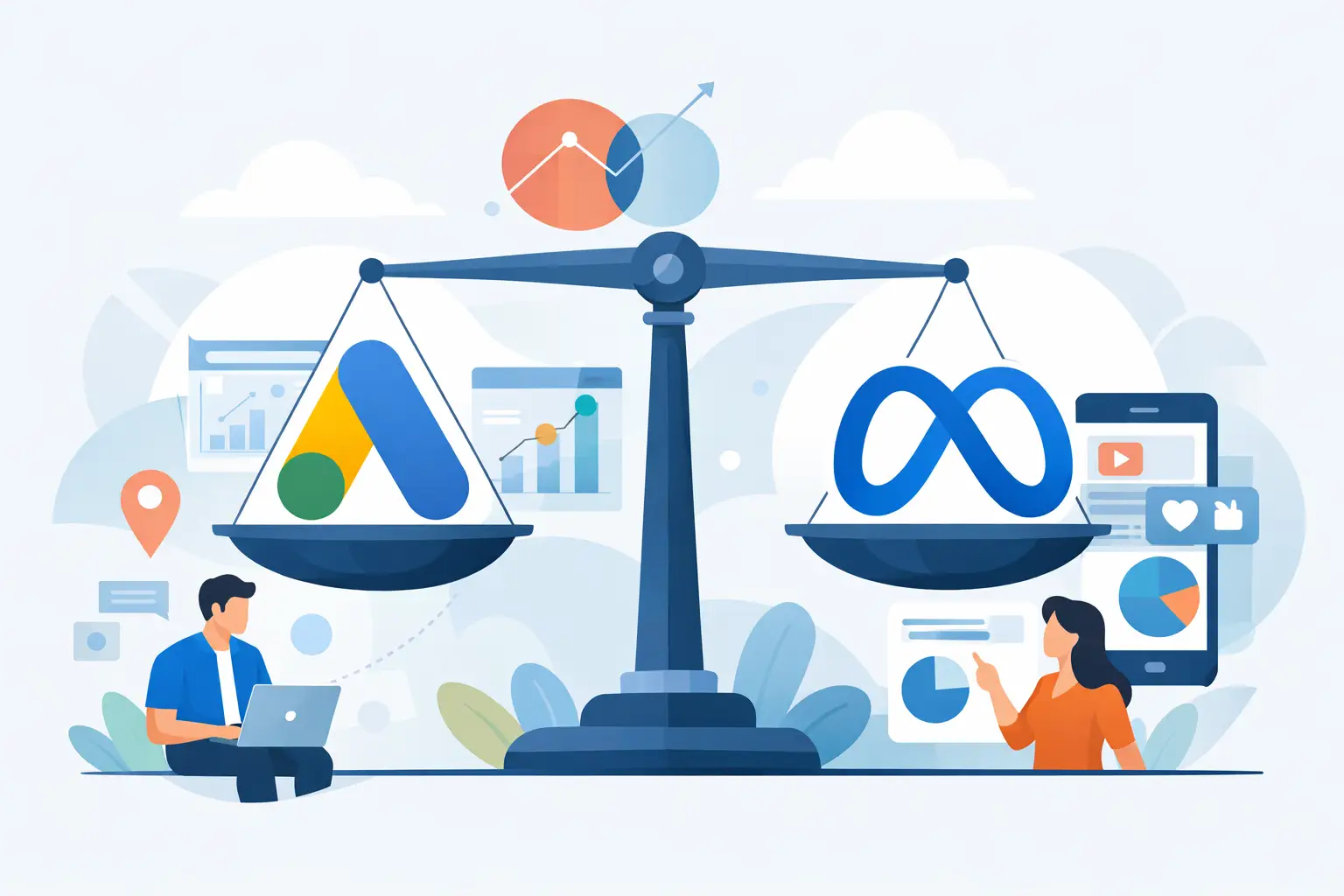
Choosing between Google Ads or Meta Ads often seems like a simple decision until the budget starts demanding results. That's where many businesses discover it's not about choosing the most popular platform, but the one that best fits their business objective, their offer, and the moment their customer is ready to buy.
The right question isn't just which one works best, but what each one works best for. When analyzed from sales, lead generation, and return, the difference becomes much clearer.
Google Ads or Meta Ads: The Real Difference
Google Ads works largely on intent. The user is searching for something, comparing options, or needs to solve a specific problem. If someone types “labor lawyer,” “dental clinic,” “invoicing software,” or “furniture store,” there's already an active need. Advertising appears precisely at that moment.
Meta Ads, on the other hand, works better for discovery and persuasion. The user isn't always actively looking for what you're selling, but they can become interested if the ad connects with a latent need, desire, or opportunity. Facebook and Instagram excel when creativity, targeting, and the offer are well-crafted.
To put it directly: Google captures existing demand; Meta helps create and expand it, and moves the user towards conversion. Neither is superior in all cases. It depends on the context.
Google Ads is most beneficial when you want to reach potential customers actively searching for your products or services. It's ideal for: * **Driving immediate sales and leads:** When you have a clear offer and want to attract people ready to buy or inquire. * **Launching new products or services:** To quickly get the word out and generate initial interest and traffic. * **Increasing brand awareness:** For businesses looking to get their name and offerings in front of a wider audience. * **Targeting specific demographics or locations:** To reach a precise audience that is most likely to be interested in what you offer. * **Promoting special offers or events:** To create urgency and drive traffic for limited-time opportunities. * **Competing with rival businesses:** To ensure your products or services are visible when potential customers are searching for solutions your competitors also offer. * **Measuring performance and optimizing:** Google Ads provides detailed analytics, allowing you to track what's working and refine your campaigns for better results. In summary, Google Ads is highly effective when you need to connect with an audience that is already looking for what you provide, or when you need to proactively reach out to a targeted group.
If your company offers a service that people are already clearly searching for, Google Ads often has a significant advantage. This is the case for businesses where the decision starts from an explicit need: legal services, healthcare, repairs, education, consulting, tourism with a defined intention, or e-commerce with specific searches.
In these scenarios, traffic is usually warmer. This doesn't mean it's always cheap or that it closes on its own, but it does mean the user arrives with a higher level of interest. This reduces friction and, in many sectors, improves the conversion rate.
Google Ads is also often a more efficient option when you need to measure returns very close to the sale. Because there's a more direct relationship between search and need, it's easier to understand which keywords attract real opportunities and which just consume budget.
Now, it has its limits. In highly competitive sectors, the cost per click can rise rapidly. Additionally, if hardly anyone is searching for your product because it's new, complex, or little-known, Google can fall short in volume. That's where Meta gains ground.
Signs that Google Ads May Be Your Best Channel
It's usually the best choice if your client already knows what they need, if your service solves an urgent problem, if the decision-making process is short, or if you want to capture demand with clear intent. It also works very well when the business depends on specific geographic locations and needs immediate visibility in local searches.
When is Meta Ads most beneficial
Meta Ads stands out when the product or service needs explanation, visual trust, or prior desire building. It is especially powerful for consumer brands, e-commerce, projects with a strong aesthetic component, aspirational services, training, events, franchises, and businesses that need to scale audiences.
Facebook and Instagram allow showing content before the user searches. This completely changes the campaign logic. Instead of waiting for demand to appear, the brand activates it with content, offers, social proof, videos, testimonials, and remarketing sequences.
For companies with a strong visual proposition, Meta can generate very competitive results. It also tends to perform well when working with a database, a lookalike audience, or a retargeting strategy that follows the user through multiple touchpoints.
The challenge is that it's not enough to segment and publish. If the ad doesn't grab attention in seconds, if the offer is weak, or if the landing It doesn't convert, the campaign quickly loses momentum. Meta demands more creative work and more consistency in message optimization.
Signs That Meta Ads Can Be Your Best Channel
It makes more sense if your brand needs visibility, if the user isn't actively searching for a solution yet, if you sell on impulse or affinity, or if your strategy depends on building community, trust, and recognition before closing the sale.
Google Ads or Meta Ads depending on the objective
When the main goal is to generate high-intent leads, Google Ads usually has an advantage. A contact form for a firm, clinic, or B2B company will typically perform better when triggered by someone already searching for that service.
When the goal is to raise brand awareness, launch a product, or expand market reach, Meta Ads often offers a more attractive cost per reach. Additionally, it allows for greater flexibility in testing messages, creatives, and audiences.
In e-commerce, the decision becomes more nuanced. Google Ads can capture product searches with clear purchase intent, while Meta drives demand, recovers users, and improves reach frequency. Many stores sell more when they combine both platforms, not when they choose just one.
In businesses with high-ticket items or slower decision-making processes, Meta can warm up the user, and Google can close the opportunity when the intent matures. Therefore, separating platforms as if they were always competing against each other is too narrow a view.
The budget also changes the answer
With reduced budgets, the recommendation depends heavily on the type of business. If there is clear and measurable demand, concentrating investment in Google Ads can generate faster results. You invest where there is already active search and cut down on dispersion.
If the brand needs to establish itself in the consumer's mind, Meta can be a better first move, especially when the cost per click on Google is high or when there isn't enough recognition yet to compete in searches.
What usually fails is not the platform, but trying to do too many things with too little budget. Spreading a limited investment across campaigns, audiences, and formats without a clear priority almost always dilutes performance.
The most common mistake: choosing based on trends
Many companies enter Google Ads because “everyone searches on Google” or Meta Ads because “Instagram sells.” Both ideas have some truth to them, but taken without a strategy, they often end up in unprofitable campaigns.
The right choice starts with four questions: what are you selling, who are you targeting, what stage is the customer in, and what specific action do you want to achieve. To that, we must add something that is rarely seriously evaluated: if the business has a website, an offer, and a sales process. ready to convert.
It's pointless to drive high-intent traffic to a slow, confusing, or unclear value proposition page. Nor is it useful to launch attractive visual ads on Meta if the sales follow-up takes days or the form asks for too much. The problem isn't always with the ad spend. It's often with everything that happens after the click.
The best answer for many businesses: combine
Framing Google Ads or Meta Ads as an absolute dilemma can lead to missed opportunities. In many cases, combining them is what generates the best results. Meta helps build brand awareness, capture audiences, and nurture interest. Google captures some of that demand when the user is already comparing, researching, or ready to move forward.
Moreover, cross-platform remarketing enhances the entire journey. A user might discover a brand on Instagram, search for it later on Google, and convert after several touchpoints. This behavior is becoming increasingly common.
From a growth perspective, it's not smart to fall in love with the channel, but with the system. A system where advertising, landing page, automation, sales tracking, and measurement work as a single strategy. That's where an agency with a comprehensive approach, like CLICK Digital, can make a real difference.
How to make a decision with sound judgment
If you need immediate results on existing demand, start with Google Ads. If you need to generate interest, showcase value, and foster consideration, start with Meta Ads. If your business has a longer purchase process, an attractive average ticket price, and room to scale, you'll likely need both at different stages of the funnel.
The key isn't to ask which platform is better in general. The key is to understand which one gets your company closer to real customers, measurable sales, and sustainable growth, faster.
If your advertising investment still isn't translating into business opportunities, perhaps you don't need more ads. Perhaps you need a better strategy connected to how your customers discover, compare, and decide.
