
Blog
AI Agents for Sales: When They Actually Work

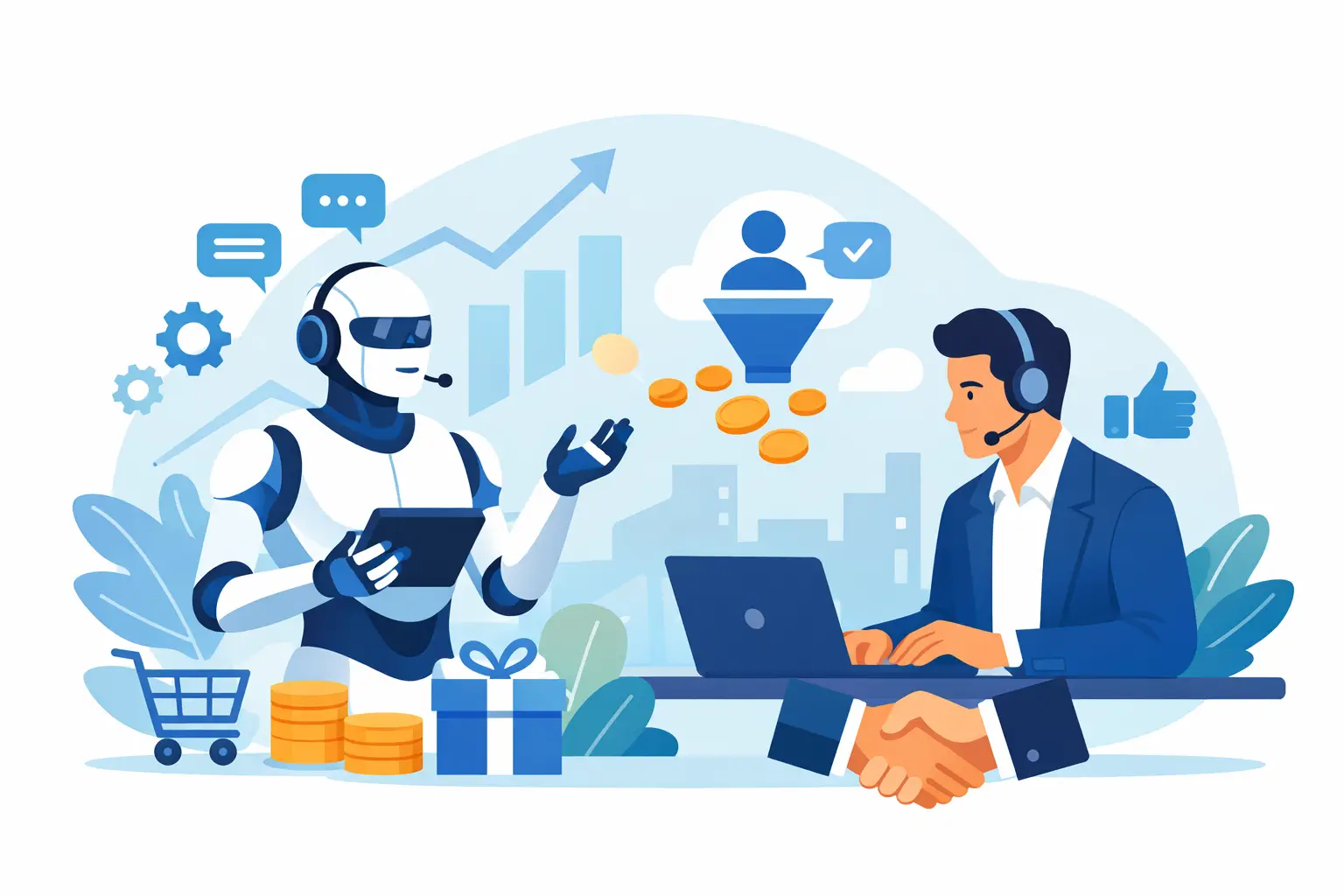
Sales teams lose many opportunities not because of a lack of demand, but because they are late, provide incomplete responses, or miss valuable conversations. That's where AI agents for sales start making a difference: they respond instantly, filter contacts, answer repetitive questions, and push each lead to the next step without unnecessary friction.
The promise sounds attractive, but it's worth grounding the concept. It's not about replacing salespeople with a bot that has pretty answers. It's about incorporating operational intelligence at key moments in the sales process to gain speed, consistency, and tracking capability. When implemented well, these agents don't just save time. They also improve conversion.
What really are AI agents for sales
An AI agent for sales is a system designed to interact with potential customers, understand context, respond with business logic, and execute actions within the sales funnel. It can operate on the web, WhatsApp, forms, social media, or even integrate with CRMs, sales calendars, and automation tools.
The difference compared to a basic chatbot is the ability to interpret intent, remember conversation data, adapt responses, and guide the user towards a specific goal. This goal could be scheduling a call, qualifying a lead, recommending a service, recovering an abandoned cart, or following up on an open opportunity.
Simply put, it's not just automated attention. It's a commercial layer that works 24/7 and, if well-trained, acts with criteria close to those of a very organized junior sales advisor.
Where do they generate more value in a business
Not all companies need the same type of agent or at the same point in the customer journey. That's often where one of the first wrong decisions is made: installing AI just because it's trendy, without identifying the real bottleneck.
If a company receives many messages and takes hours to respond, the value lies in immediate attention. If the problem is that unqualified leads are arriving, the focus should be on filtering questions. If the sales team is drowning in manual follow-ups, what's needed is to automate reminders, recontacts, and opportunity reactivation.
In service businesses, agents tend to perform very well in initial capture, prequalification, and scheduling. In e-commerce, They work particularly well for product recommendation, sales recovery, and pre-purchase support. For companies with longer processes or high ticket values, their greatest contribution lies in streamlining the sales pipeline and preventing leaks between marketing and sales.
AI Agents for Sales and Real Returns
The correct question is not whether AI sells by itself. The correct question is how much it improves the performance of an existing business system. In practice, the best results appear when the agent solves three problems simultaneously: response speed, consistency of discourse, and follow-up continuity.
Responding in seconds changes the game, especially in paid campaigns Hot traffic. A lead coming from Google Ads, Meta Ads, or a well-optimized landing page has active intent. If it doesn't receive quick attention, it will compare, cool off, or end up speaking with another provider. An AI agent can intervene at that critical moment, gather key information, and move the conversation forward without depending on the team's schedule.
It also brings consistency. Many businesses have good salespeople, but inconsistent sales responses. A prospect might receive excellent attention in the morning and very poor attention in the afternoon. AI helps unify criteria, messages, common objections, and calls to action. While this doesn't replace human closing in all cases, it does reduce costly errors.
The third point is follow-up. Sales are lost here every day. Leads who requested information, contacts who showed interest and never received a second message, opportunities that did not advance due to a simple lack of order. An agent well-connected to the process can reactivate these conversations with logic and opportune timing.
When they don't work so well
It's important to be clear: AI agents for sales do not fix a weak offer, a confusing website, or a poorly conceived lead generation strategy. If there's no value proposition, qualified traffic, or sales process, AI only automates chaos.
They also don't work well when forced to close complex sales without sufficient context. In consulting services, B2B decisions, or projects with multiple variables, it's common for the agent to prepare the ground and transfer the lead to the appropriate advisor. Forcing AI to do everything usually worsens the experience.
Another frequent error is using generic responses that sound artificial. If the tone doesn't match the brand, if the responses don't resolve real doubts, or if the system doesn't understand the user's questions, the effect can be the opposite: distrust and abandonment.
How to implement AI agents for sales without complicating the process
The best implementation isn't the most spectacular, but the most useful. Before setting up tools, it's advisable to answer four questions: what business task do you want to improve, what data does the agent need, when should a person intervene, and how will the result be measured.
That order matters. Many companies start with the platform and then try to adapt the business to the tool. The smart thing to do is the opposite. First, define the ideal commercial flow. Then, train the agent to fulfill a specific function within that flow.
In the first phase, it's usually more cost-effective to start with a specific use case. For example, handling incoming leads from campaigns, classifying by interest and budget, or automatically scheduling calls. This allows for quick impact validation without restructuring the entire business.
Next comes a key stage: training. A sales agent needs to be familiar with frequently asked questions, objections, indicative pricing, coverage areas, client types, qualification criteria, and brand tone. They must also know when to insist, when to escalate, and when to stop pushing. That logic is as important as the technology.
Finally, supervision is necessary. AI improves with real data, but it shouldn't be left alone for weeks expecting miracles. Conversations need to be reviewed, friction points detected, responses adjusted, and it needs to be measured if it's truly generating more meetings, more opportunities, or more sales.
Integration with marketing changes the outcome.
Here many companies fall short. An isolated agent can help. An agent connected to the complete digital strategy can multiply results.
If the lead comes from campaigns, SEO, social media, or web forms, the agent should receive context about the lead's source and adapt the conversation. It's not the same to talk to someone who is urgently looking for a solution on Google as it is to talk to a user who saw an ad on Instagram and is just exploring options.
When marketing and sales work on the same system, AI can enrich data, detect intent, segment audiences, and provide useful insights to optimize campaigns. This not only improves commercial response but also enhances the quality of customer acquisition.
That comprehensive approach is what truly generates competitive advantage. It's not about putting a virtual assistant on the web to say the company uses AI. It's about connecting visibility, lead generation, automation, and closing within the same growth logic.
What should a company ask for before hiring this solution?
It's not enough for them to promise you automation. A company should ask for clarity on the agent's true scope, the channels where it will operate, its integration with their current tools, and the indicators that will be worked on.
It's also worth checking if the solution fits the business process or if it forces too much simplification. In some businesses, an agent is needed to ask qualifying questions and route leads. In others, it's beneficial to have one that recovers cold leads. In others, the priority is to reduce operational load in customer service and pre-sales support.
Furthermore, there's a practical issue that shouldn't be ignored: the quality of implementation depends heavily on who designs it. A provider focused solely on technology may leave out essential business variables. Conversely, when the solution stems from a broader vision of acquisition, conversion, and automation, the agent tends to perform better. That's where an agency with a 360-degree focus, like CLICK Digital, can bring more value than a purely technical implementation.
The business future is not human or AI, but human plus AI.
The companies that are selling best are not the ones eliminating people from the process. They are the ones reserving human time for what truly requires it: diagnosing, negotiating, closing, and building relationships. Everything else – Respond quickly, ordering data, qualifying, remembering, reactivating – it can and should be optimized.
AI agents for sales make sense when they translate into more opportunities handled, fewer leaks, and a more focused sales team. Not for hype, but for performance. If your company is already investing in visibility and lead generation, but still loses momentum on response or follow-up, you probably don't need more noise. You need a smarter sales engine.
