
Blog
Google Ads vs. Facebook Ads: Which is better?

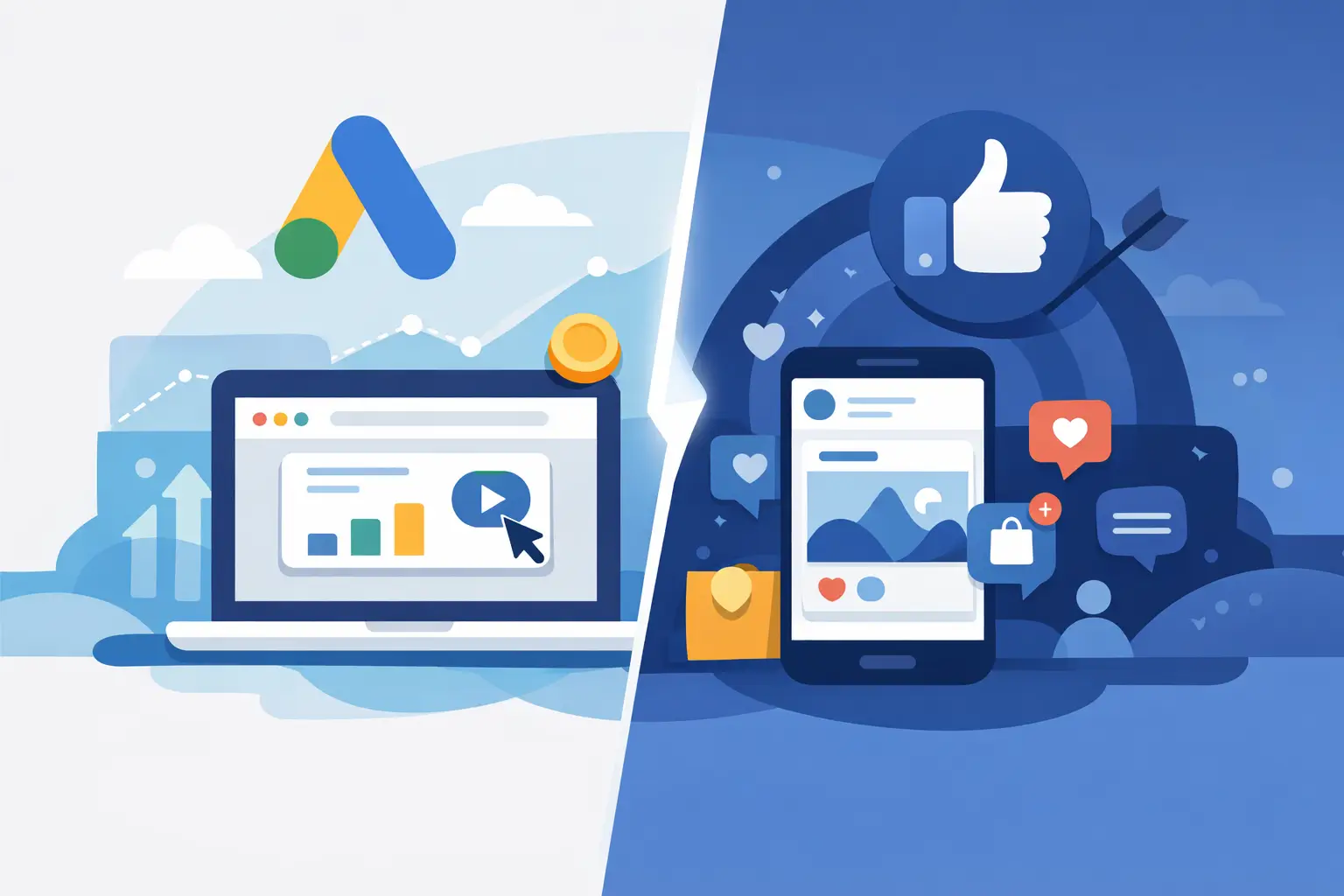
There's a difference that completely changes the outcome of a campaign: on Google, the user is already looking for a solution; on Facebook and Instagram, you normally have to spark interest first. That's the real basis of the google ads vs. facebook ads debate, and also why many businesses invest in the wrong channel for their business stage.
When a brand needs to generate sales, leads, or visibility, simply choosing the most popular platform isn't enough. What matters is understanding how your customer buys, how long they take to decide, and what type of message they need to move forward. From there, the comparison stops being a theoretical discussion and becomes a strategic decision.
Google Ads vs. Facebook Ads: The Fundamental Difference
Google Ads works on search intent. People type something specific like “labor lawyer,” “dentist in San Jose,” or “buy air conditioner” because they already have an active need. This often makes the traffic more direct and closer to converting.
Facebook Ads, within the Meta ecosystem, works differently. The platform detects profiles, behaviors, interests, and lookalike audiences to show ads while the user browses their feed, stories, or Reels. Here, there isn't always an immediate purchase intent. Therefore, the ad, the offer, and the targeting weigh much more.
Neither platform is better in absolute terms. They are different tools for different customer moments. If used well, they can complement each other. If used poorly, both can quickly burn through budget.
When Google Ads usually performs best
Google Ads is usually stronger when demand already exists and the user knows what they need. This happens a lot in professional services, healthcare, education, tourism, e-commerce with specific products, and local businesses that rely on geolocated searches.
If a company sells something that people search for by name, category, or urgency, Google has a clear advantage. Consider someone who needs a locksmith, a cosmetic clinic, accounting software, or specific spare parts. In these cases, appearing right when the user searches can generate high-quality leads.
It's also a very valuable platform for measuring commercial intent. Someone who sees an ad out of marketing interest is not the same as someone who searches for “Google Ads agency in Costa Rica.” The second person is already much closer to hiring.
That said, this advantage comes at a cost. In competitive sectors, a click can be expensive. Also, if the landing page It's not well-built, the budget is wasted all the same. Google doesn't fix a bad value proposition or a slow website.
Common advantages of Google Ads
The main one is capturing existing demand. Additionally, it allows for very specific searches, measuring conversions quite accurately, and scaling campaigns with business logic. For businesses that need leads with clear intent, it is often a central piece.
Its limitation appears when the market is not actively seeking the product, when the brand is little known, or when the purchase decision requires prior education. In those scenarios, Google alone may fall short.
Facebook Ads tend to perform best
Facebook Ads stand out when a brand needs to generate attention, educate the market, or impact very specific audiences. It is especially useful for visual products, promotions, launches, e-commerce, businesses with an aspirational component, and campaigns focused on awareness or remarketing.
If the customer isn't actively searching yet, Meta allows you to put your offer in front of the right person before they even start looking. This is very powerful for fashion, beauty, food, online courses, real estate, events, and brands that sell based on an emotional or lifestyle proposition.
Additionally, creativity is key here. A good visual, a clear message, and a well-presented offer can quickly move results. The platform rewards content that connects with the audience, not just the bid.
But it must also be said clearly: a bad Facebook and Instagram campaign can generate many pretty metrics and few sales. Reach, clicks, or plays do not guarantee business. If there is no strategy, commercial follow-up, and real measurement, performance may seem better than it is.
Common Advantages of Facebook Ads
Meta offers very useful segmentation for finding lookalike audiences, working on funnels, and re-engaging those who have already interacted with the brand. It's usually more flexible for testing creatives, messages, and formats. It can also help build brands faster than Google in certain categories.
Its weak point shows up when very immediate conversions are needed for high-intent services or when the business depends on urgent searches. Google usually has an advantage there.
Google Ads vs. Facebook Ads According to Business Objective
The most useful way to choose is not to ask yourself what platform is trending, but what goal you want to achieve.
If the goal is to capture leads with active needs, Google Ads is usually the first choice. If the goal is brand awareness, generating interest, or nurturing an audience before selling, Facebook Ads usually fits better.
If the goal is to sell products with visual appeal, Meta can work very well. If the goal is to capture high-value transactional searches, Google typically offers more prepared traffic. And if the goal is to re-engage users who have already visited the website or abandoned a cart, both platforms can contribute, although Meta is often especially powerful for creative remarketing.
There is another relevant factor: the sales cycle. The shorter and more evident the problem, the more sense Google usually makes. The longer, more emotional, or consultative the process, the more value Meta can bring in the consideration phase.
Budget, costs, and return: where's the nuance
Many companies ask which platform is cheaper. The correct answer is: it depends on the sector, the competition, and the quality of the campaign.
Google may have a higher cost per click, but it also has superior purchase intent. Meta can offer cheaper traffic, but that doesn't mean the cost per final sale is better. A cheap click that doesn't convert is expensive. An expensive click that generates profitable customers can turn out very well.
That's why it's wise to look at the entire business: cost per lead, conversion rate, average customer value, closing time, and margin. Not just cost per click or CPM. At a strategic level, the right platform is one that generates sustainable profitability, not one that shows fancier metrics on the dashboard.
The most common mistake: choosing an isolated channel
One of the least profitable decisions is to frame Google Ads vs. Facebook Ads as if you had to choose only one forever. For many companies, the best answer isn't to choose, but to combine them in an ordered way.
Google can capture existing demand. Meta can create, reinforce, and recover it. Together, both platforms allow for improved recognition, consideration, conversion, and remarketing with wider reach.
A simple example: a company runs ads on Meta to increase brand awareness, capture qualified traffic, and build audiences. Then, when that user searches for the brand or a related solution on Google, they appear again. This dual presence increases trust and usually boosts conversions.
This approach works especially well when accompanied by an optimized website, clear forms, business automation, and lead tracking. Advertising alone doesn't fix a broken funnel.
How to make good decisions in your case
The right choice starts with three questions. Is your client already looking for what you sell? Do you need to educate the market before closing a sale? Do you have a clear system for converting traffic into real opportunities?
If there's active search and commercial intent for a quick response, Google likely should be at the center. If you need to build demand, differentiate your offering, or impact specific audiences with creativity, Meta might be the best starting point.
If the company is already investing and not seeing results, the problem isn't always with the platform. Often it's with the offer, the targeting, the landing page experience, or the lack of measurement. That's where a comprehensive vision makes the difference. It's not just about setting patterns, but about connecting strategy, acquisition, conversion, and tracking.
At CLICK Digital, we work precisely from that logic: not choosing channels out of habit, but based on profitability, context, and commercial objective.
The best investment isn't the one that brings the most clicks, but the one that brings your business closer to more sales, more control, and growth that can be sustained month after month.
