
Blog
What is marketing automation

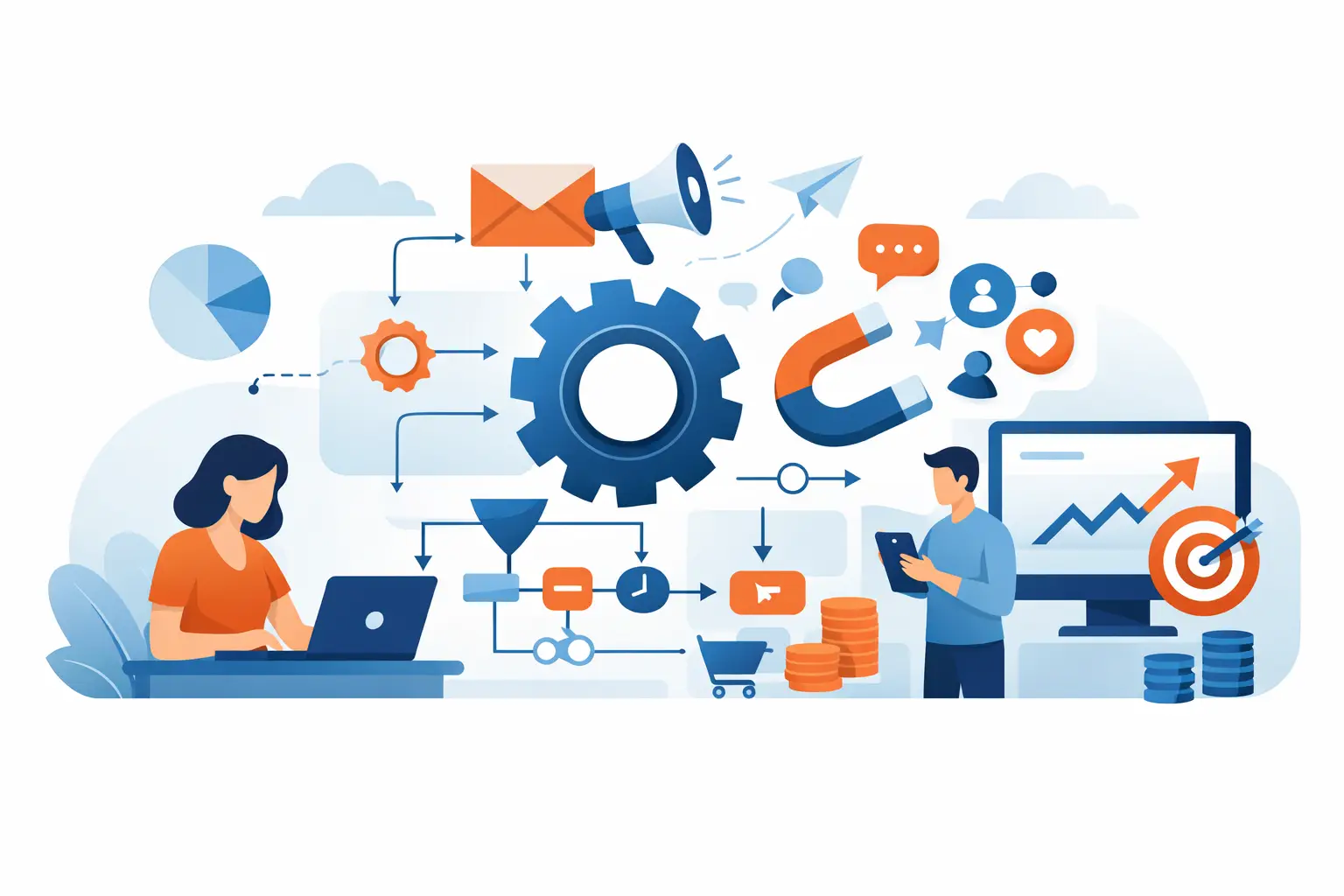
There are companies that invest in ads, social media, and websites, but continue managing their contacts with spreadsheets, manual responses, and follow-ups that depend on whether someone remembers or not. That's where understanding what marketing automation is stops being a technical curiosity and becomes a business decision.
Marketing automation consists of using technology to automatically execute marketing and sales actions based on the behavior, data, or stage of each contact. It's not just about scheduling emails. It's about creating processes that attract, qualify, nurture, and push real opportunities toward conversion without the team having to do everything manually.
For a small to medium-sized business (SME), a growing brand, or a sales team with limited time, this changes much more than operations. It changes responsiveness, follow-up quality, and the ability to scale without proportionally increasing costs.
What is marketing automation and how does it work
When a person fills out a form, downloads a catalog, requests a demo, or abandons a cart, they leave behind signals. Marketing automation converts those signals into predefined actions. If the user does X, the system executes Y. If they also meet certain conditions, they move to another phase of the process.
A simple example: someone enters a landing page, leaves their information to receive information about a service, and automatically receives a welcome email. If they open that email, they can receive a second message with a success story. If they also click, the system can assign them to the sales team as a lead with higher interest. If they don't interact, they enter a different sequence with more educational content.
This means that marketing stops operating on intuition or by accumulating manual tasks. It starts working with logic, criteria, and workflows designed to move the contact towards the next action.
It's not just email marketing
One of the most common mistakes is thinking that marketing automation is limited to sending automatic emails. Email remains a powerful tool, but the system can encompass much more: forms, audience segmentation, lead scoring, remarketing, WhatsApp messages, CRM, chatbots, sales team alerts, and even internal tasks.
That's why when a company asks what marketing automation is, the real answer shouldn't focus on a specific tool, but on the ability to connect channels and processes to generate more opportunities and manage them better.
In businesses with short sales cycles, automation helps to respond faster and close more deals. In businesses with longer decision-making processes, it helps to educate the lead and keep the relationship active until the time of purchase. In both cases, the value lies in not losing contacts due to a lack of follow-up.
What problems does it solve in a company?
Many companies don't have a demand problem, but a management problem. They generate inquiries, receive forms, get social media messages, or website visits, but then the sales process breaks down. No one responds in time, there's no segmentation, tasks are repeated, and leads go cold.
Automation addresses several of those pain points. It allows for immediate responses, classifying contacts by real interest, sending relevant content, and maintaining constant follow-up without burdening the team with repetitive work. It also reduces human errors, improves traceability, and provides more visibility into which campaigns are generating business and which are just generating noise.
That said, automation doesn't fix a weak value proposition or a poorly conceived strategy. If the message isn't convincing, the traffic isn't right, or the offer isn't clear, automation only speeds up a problem that already existed. It works best when it's built on a solid strategic foundation.
Real Benefits of Marketing Automation
The first benefit is time. Tasks that previously required checking emails, copying data, or manual follow-ups now run automatically. This frees up hours for the team, allowing them to focus on more profitable decisions.
The second is conversion. When a company responds faster, segments better, and guides the lead with relevant messages, the chances of a sale increase. Not by magic, but because the sales process gains consistency.
The third is scalability. A business can handle more contacts without needing to increase the team at the same rate. This is especially useful for lead generation campaigns, product launches, e-commerce, and services with a high volume of incoming leads.
There's also a less visible, but very important benefit: data quality. Good automation makes it clear where each lead came from, what they did, what content they consumed, and where they got stuck. This allows for campaigns to be optimized with sound judgment, not just intuition.
Where is it best applied
Automation is especially well-suited for companies that are already generating traffic or capturing leads and want to convert better. For example, businesses investing in Google Ads or Meta Ads, brands with website forms, e-commerce stores with abandoned carts, sales teams receiving many inquiries, or companies offering services with consultative sales processes.
It also makes a lot of sense when there are multiple touchpoints before a purchase. If a customer needs to compare, consult, think about it, or talk to sales, automating follow-up prevents the opportunity from going cold between interactions.
On the other hand, if a company doesn't yet have a clear offering, receives very little traffic, or lacks a minimum lead generation process, it might not be the first lever to pull. In those cases, it's better to first organize the digital strategy, the business proposal and core assets like the website or campaigns.
What does automation need to work well?
The tool matters, but design matters more. Effective automation starts with clear objectives. It's not enough to say “we want to automate.” You need to define whether you're looking to capture more leads, improve qualification, recover opportunities, increase repeat sales, or reduce operational load.
Next comes the process architecture. What activates each flow, what conditions separate a cold lead from a hot one, what content each profile receives, and when a team member intervenes. This is where many implementations fail. They automate too early or automate without considering the user experience.
Content is also needed. If the system is going to nurture leads, there must be useful messages, coherent offers, and well-placed calls to action. Automating generic messages usually produces generic results.
And finally, measurement. Automation without periodic review ends up outdated. Campaigns change, user behavior changes, and friction points change. What worked six months ago may be losing effectiveness today.
Automation, AI, and Sales: How They Connect
More and more companies are blending marketing automation with artificial intelligence, but it's important to separate the concepts. Automation executes rules and processes. AI adds advanced analytical capabilities, personalization, conversational responses, or prioritization.
For example, a chatbot can answer frequently asked questions, filter inquiries, and route contacts ready to speak with sales. An AI-powered system can help identify which leads are most likely to convert or suggest the best time to contact them. The combination is powerful because it brings together operational efficiency with smarter decisions.
Still, not everything needs AI. In many businesses, good basic automation already solves a large part of the problem. The priority should be to build a clear and profitable process. Afterward, if it makes sense, a more advanced layer is incorporated.
The error of automating for fashion
Some companies implement complex platforms because they sound modern, but they are unclear about which process they want to improve. They end up paying for underutilized tools, sending irrelevant flows, or generating friction instead of sales.
Automating for the sake of automation often leads to two extremes. The first is an overload of messages, which wears out the lead and erodes trust. The second is a technical dependency that no one within the company knows how to manage. That's why it's worth approaching it as a business investment, not a software purchase.
At this point, working with a strategic partner makes all the difference. Not just for setting up tools, but for connecting lead generation, follow-up, conversion, and measurement within a single business logic. That approach is what allows automation to deliver real results.
CLICK Digital works precisely on that integration between digital strategy, lead generation, automation and applied artificial intelligence, with a vision focused on commercial growth and efficiency.
The best way to understand marketing automation is not to see it as a system that replaces people. It's to see it as a framework that prevents losses, speeds up responses, and allows your team to focus on selling better. When well-designed, it doesn't make marketing seem more automatic. It makes the business run with more discernment, more control, and more capacity to grow.
