
Blog
Chatbot or AI agent: which one is better?

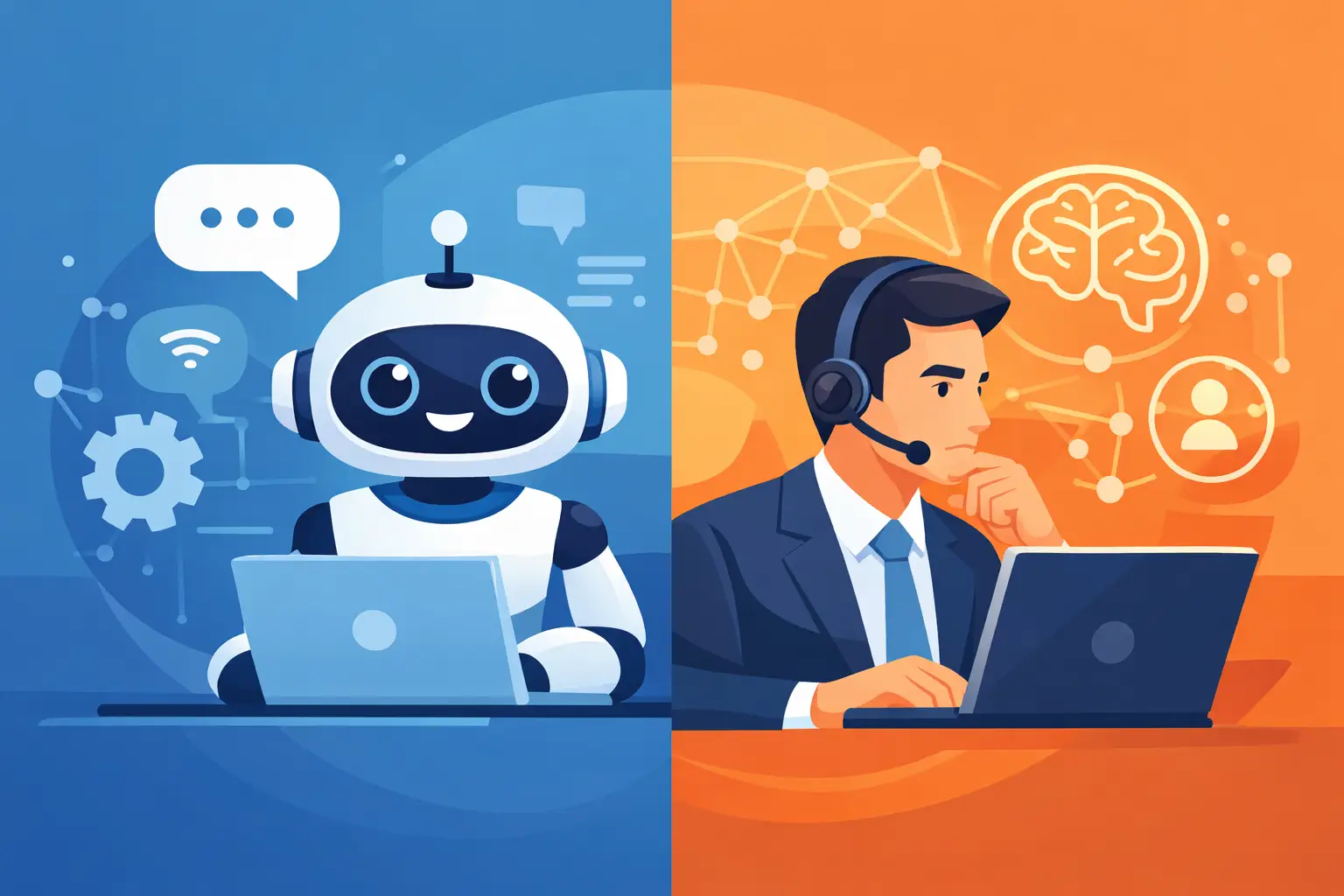
Many companies reach the same point after investing in web, social media, or campaigns: leads come in, but follow-up fails, responses are delayed, and the sales team wastes time on repetitive tasks. This is where the big question arises: chatbot or AI agent. It's not a matter of trend, but of performance. Choosing correctly can make the difference between automating a part of the work or truly improving how your business captures, serves, and converts.
Confusion is normal because both concepts are often confused. At first glance, both respond to messages, handle inquiries, and function on channels like WhatsApp, the web, or social media. However, in practice, they don't resolve the same things, they don't require the same level of strategy, nor do they generate the same impact on sales, support, or operations.
Chatbot or AI agent: they are not the same
A traditional chatbot works with rules, flows, and predefined responses. If the user writes something that fits within the conversation tree, the system responds well. If they go off the intended path, the experience breaks or ends with a generic response.
That doesn't mean a chatbot is bad. In fact, it remains useful for specific and repetitive tasks. For example, answering schedules, sharing locations, collecting initial data, or filtering basic queries. When the volume is high and the questions are very similar, a chatbot can save time and organize attention.
An AI agent goes further. It doesn't just follow a fixed script, but interprets intent, understands context, formulates more natural responses, and can execute actions connected with other systems. Instead of just answering, it can help sell, qualify leads, retrieve information, schedule appointments, follow up, and escalate cases with more discretion.
The real difference lies in adaptability. A chatbot responds. An AI agent converses, analyzes, and supports processes with greater operational intelligence.
When a chatbot is still a good decision
Not all companies need to start with an advanced agent. There are scenarios where a well-designed chatbot offers a quick and sufficient return. This is typically the case for businesses with very repetitive inquiries, little conversational variability, and a clear need for immediate after-hours support.
Let's think about a clinic that always receives the same questions about specialties, schedules, and location. Or a business that needs to answer questions about payment methods, delivery times, and general availability. If the goal is to reduce basic operational load and not manage complex conversations, a chatbot can perfectly fulfill that role.
It's also useful when the budget is tighter or when the company doesn't yet have clear business processes. Before automating with more intelligence, it's advisable to organize the data: what questions are received, what answers are repeated, which channels generate more demand, and at what points opportunities are lost.
The error is in expecting something from a chatbot that it wasn't designed for. If your team needs more flexible conversations, customer tracking, or consultative support, a rigid system will fall short very soon.
When does an AI agent provide more value
An AI agent makes sense when the conversation directly influences sales, customer experience, or internal efficiency. It's especially powerful for companies that receive leads from campaigns, forms, social media, or organic traffic and need to respond quickly with more personalized messages.
Here we're no longer just talking about answering questions. We're talking about detecting purchase intent, asking useful questions, filtering quality leads, recording information, referring to the right salesperson, and maintaining continuity in the conversation. That difference has a direct impact on conversion.
It is also a better option when there are multiple scattered sources of information. An AI agent can consult databases, catalogs, internal FAQs, or CRM integrations to respond more accurately. This reduces service times and improves service consistency.
In support, value also grows. If a customer writes in with a specific problem, the AI agent can interpret the case, ask for relevant data, offer an initial solution, and escalate with full context to the human team. Less friction, fewer repetitions, and a more streamlined experience.
The right decision depends on your business process
The question shouldn't just be chatbot or AI agent, but what part of the process do you want to improve? If your bottleneck is in answering frequently asked questions, you probably don't need to go to the most advanced level from day one. But if the problem is losing opportunities due to lack of follow-up, cold responses or poor qualifications, an AI agent makes more sense.
Some companies believe they need artificial intelligence when in reality they need a better customer service structure. Others do the opposite: they install a basic chatbot and expect it to improve their sales, even though the funnel requires more consultative conversations.
That's why technology shouldn't be chosen in isolation from the business. You need to look at its customer acquisition channels, the type of customer, the volume of inquiries, the complexity of the offer, and the cost of not responding well or on time. Useful automation starts with understanding the process, not by installing a tool.
Factors to consider before deciding
The first is the complexity of inquiries. If most messages can be resolved with closed options, the chatbot can function. If the questions change a lot and require context, the AI agent offers more room.
The second is the value of each lead or customer. When a single business opportunity has a high ticket value, losing it due to a poor conversation is expensive. In those cases, it's worth investing in a smarter experience that is closer to genuine consultative service.
The third factor is integration. If your company works with CRM, scheduling, inventory, support systems, or business automation, an AI agent can become a productivity tool, not just for customer service. That's where it starts generating value in various areas at once.
Supervision needs also play a role. A chatbot is usually easier to control because it responds within closed boundaries. An AI agent demands design, training, testing, and monitoring. In return, it delivers more flexibility. It's not better by definition, but it is more powerful if implemented judiciously.
What many companies overlook
The real problem usually isn't the tool, but the strategy behind it. A system is installed because “we need to automate,” but no one defines objectives, use cases, brand voice, escalation rules, or success metrics. The result is automation that responds, but doesn't help.
For a chatbot or AI agent to work, it must be aligned with something specific: generating more qualified leads, reducing response times, offloading the team, improving sales closing, or increasing the attendance rate. If that's not clear, any implementation will remain a technical novelty without real return.
It's also worth remembering that automation doesn't mean completely replacing people. In many businesses, the best formula is a hybrid one. AI filters, responds, organizes, and accelerates. The human team steps in when it's necessary to close deals, negotiate, resolve sensitive issues, or build trust in more complex operations.
Chatbot or AI agent in marketing and sales
In digital marketing, the difference between one and the other is quickly noticeable. A chatbot can capture basic data from a landing page or a campaign. That's already useful if the goal is to not leave contacts without a response. But an AI agent can do much more: ask about budget, detect needs, classify by interest, recommend a service, and leave the sales team with a much better-prepared opportunity.
That is especially relevant when investing in Google Ads., Meta Ads SEO. It's not enough to generate traffic. You have to convert it. If the subsequent conversation is slow or poor, the cost per lead increases and the performance of the entire strategy drops. Automating that layer well improves the return on channels that are already attracting demand.
In an agency with a comprehensive approach like CLICK Digital, this difference is clearly seen because the automation It doesn't work in isolation. It connects with lead generation, funnel design, user experience, and business objectives. That's where AI stops being an extra and becomes a real competitive advantage.
So which one is better
If your company needs to resolve simple queries, streamline support, and start automating with a controlled scope, a chatbot may be sufficient. If you need more natural conversations, commercial follow-up, integration with processes, and better lead or customer management, an AI agent typically offers more scope.
The best choice is not the most advanced on paper, but the one that best suits your operations, your demand volume, and your growth objectives. When technology fits the process, it shows in less manual work, faster responses, and more converted opportunities.
Before deciding, it's worth asking yourself a very specific question: does your business only need to respond faster, or does it need to sell and operate better through intelligent conversations? The answer usually clarifies almost everything.
