
Blog
Digital marketing services that actually sell

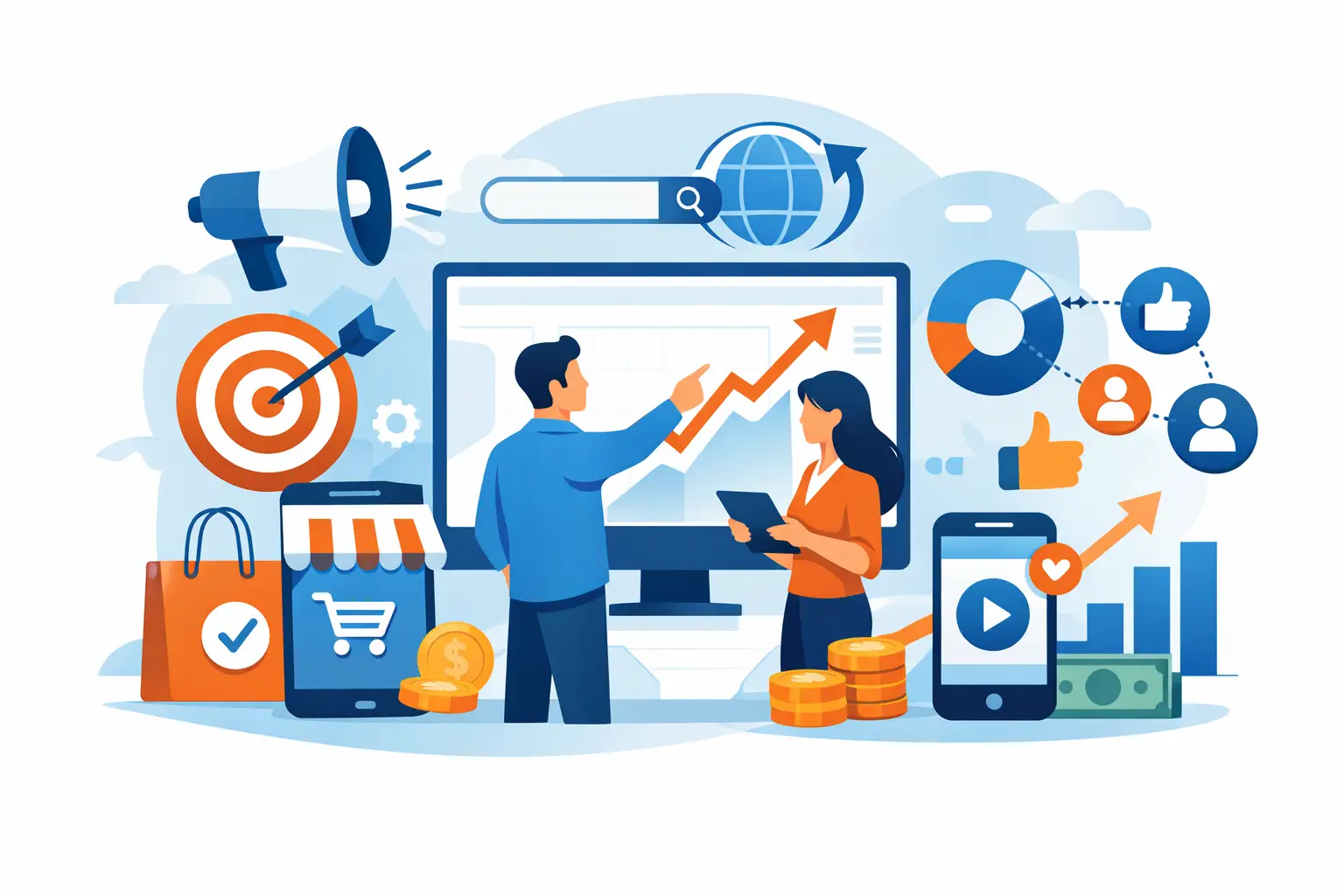
If your company invests in social media, ads, or a new website, but sales don't grow at the same pace, the problem usually isn't a lack of action. It's usually a lack of direction. That's where digital marketing services make a real difference: not as a sum of isolated tasks, but as a system designed to attract, convert, and scale.
Many companies hire design from one party, advertising from another, and content from a third. The result is usually predictable: disconnected messages, misinterpreted data, and an investment that seems to move a lot without advancing enough. When strategy, acquisition, and conversion do not work together, growth becomes slow, expensive, or inconsistent.
What does digital marketing services include today?
Talking about digital marketing is no longer just about posting on Instagram or running Google campaigns. For a company that wants to grow sustainably, digital marketing services must cover the entire commercial journey: visibility, demand generation, lead capture, opportunity closing, and process optimization.
Therefore, a serious offer usually integrates digital strategy, social media management, SEO positioning, Google Ads advertising and Meta Ads, web design and development, e-commerce, marketing automation, and, increasingly, artificial intelligence-based solutions. The key isn't to hire more things, but to know what the business needs at its current stage.
A small and medium-sized business that relies on word-of-mouth doesn't require the same approach as a brand with web traffic but no conversions. Nor does a company with a good volume of leads but slow, manual sales follow-up need the same strategy. The value lies in aligning services with the actual bottleneck.
The most common mistake: buying channels instead of strategy
It's common for companies to ask for “SEO,” “social media,” or “campaigns” as if each service could solve the problem on its own. Sometimes it works for a while, but it rarely sustains results if there's no strategy behind it.
For example, investing in ads can generate traffic quickly, but if the website doesn't convert or the offering isn't clear, the cost per lead goes up. Working on social media improves presence, but without a business-oriented content strategy, reach doesn't translate into opportunities. SEO can attract valuable visits, but it requires a solid technical foundation and patience to mature.
The useful question isn't which channel is trendy. The useful question is what combination of actions can get you closer to your business goals faster with the available budget.
Digital marketing services oriented towards results
When a company evaluates suppliers, it’s advisable to separate the “nice-to-have” services from those that move key performance indicators. Image matters, of course, but it alone doesn't guarantee growth. What truly generates return is a digital structure designed to convert attention into revenue.
Digital Strategy and Planning
This is the starting point and, frequently, the most underestimated. A well-defined strategy orders priorities, sets measurable goals, and decides which channels make sense based on the type of customer, the sales cycle, and the business's operational capacity.
Without a strategy, you do a lot and learn little. With a strategy, every action has a clear purpose: attract qualified traffic, capture leads, increase sales, build customer loyalty, or reduce commercial friction.
SEO for sustainable visibility
SEO continues to be one of the most valuable assets for companies that want to rely less on paid advertising. Being well-positioned on Google not only brings traffic. It brings intent. Someone searching for a specific solution is usually closer to buying than someone who just encounters an ad while browsing.
That said, SEO doesn't yield immediate results. It requires useful content, technical structure, correct web architecture, and a medium-term vision. For companies that need sales right away, it usually works better combined with paid advertising. For companies that want to build authority and reduce acquisition costs over time, it's an especially profitable investment.
Google Ads and Meta Ads
A well-managed digital strategy allows for accelerated results, validated offers, and rapid demand capture. Google Ads works especially well when the user is already searching for a solution. Meta Ads, on the other hand, can be very powerful for generating interest, remarketing, and lead generation campaigns with well-targeted creatives.
Here, the nuance matters: it's not just about activating ads, but about working with audiences, messages, landing pages and measurement. Many campaigns fail not because of the platform, but because of a poor business proposal or sending traffic to pages that don't convert.
Web design and development focused on conversion
A website shouldn't be a digital brochure. It should function as an active salesperson. That means loading fast, explaining clearly, addressing objections, and facilitating the next step: contact, request a quote, book, or buy.
An attractive design helps, but the priority should be conversion. A company can have a modern website and still miss opportunities if the message is confusing, the form is long, or the navigation doesn't support the purchase decision.
Social media for commercial purposes
Social media remains relevant, but not all companies need the same level of presence or the same type of content. In some cases, it serves to reinforce brand and trust. In others, it's an active channel for acquisition and remarketing. The problem arises when content is published without a strategy, just to “be present.”.
Managing them well involves defining tone, frequency, formats, objectives, and a clear connection to the sales funnel. Not every post sells, but every piece of content should serve a purpose.
Automation and artificial intelligence
Here's one of the biggest opportunities for companies that want to grow without multiplying their operational burden. Automating responses, segmenting leads, activating follow-ups, qualifying contacts, or integrating chatbots and AI agents can reduce time, improve customer service, and prevent lost sales.
It's not about replacing human relationships, but about making them more efficient. A business that takes hours to respond misses opportunities. One that automates the initial contact, organizes data, and nurtures prospects arrives better prepared for the sales moment.
How to Choose the Right Services for Your Business
Not all companies need a 360 solution from day one, but almost all benefit from a comprehensive view. Choosing wisely depends on three factors: your main objective, the exact point where growth is being held back, and your internal capacity for execution.
If the problem is visibility, the focus can be on SEO, paid advertising, or strategic content. If there's traffic but no sales, the priority shifts to the website, the offer, and the conversion experience. If leads are already coming in but follow-up is inconsistent, automation can generate a faster impact than opening new channels.
It is also worth reviewing the maturity of the business. A small company can start with a compact but well-coordinated combination. An expanding company usually needs real integration between acquisition, analytics, CRM, campaigns, and automation. The important thing is that the provider does not sell closed packages without context.
What should I demand from an agency
A good agency doesn't just execute tasks. It diagnoses, prioritizes, and proposes. It helps you understand what's working, what isn't, and why. If everything is reduced to superficial metrics like impressions or followers, there's a lack of depth.
Seek clarity in objectives, discernment in decision-making, and a methodology that connects marketing with sales. It is also reasonable to ask for technical vision and adaptability. The digital environment changes rapidly, and today it is difficult to compete with a fragmented view.
In this regard, comprehensive models like CLICK Digital's better address an increasingly common need: companies that don't want to coordinate five different providers to solve the same growth problem. A unified approach usually saves time, improves data readability, and accelerates execution.
When integration generates more profitability
Hiring separate services might seem more flexible at first, but it often ends up being more expensive. There's rework, inconsistent messaging, decisions based on incomplete data, and a lack of shared responsibility that slows everything down.
Instead, when strategy, content, guidelines, web, SEO, and automation are designed as part of the same system, each piece reinforces the others. Advertising attracts, the website converts, SEO sustains, automation follows up, and analytics allow for informed adjustments.
That's the point where digital marketing services stop being an operational expense and become a real growth lever. Not because they promise magical results, but because they organize the sales process and make the investment work more intelligently.
If your company has already moved past the stage of making do and needs a digital structure that attracts clients, converts better, and saves business time, it's worth looking beyond standalone services. Serious growth almost never comes from doing more. It usually comes from better connecting what should already be working for you.
