
Blog
Why aren't my ads converting

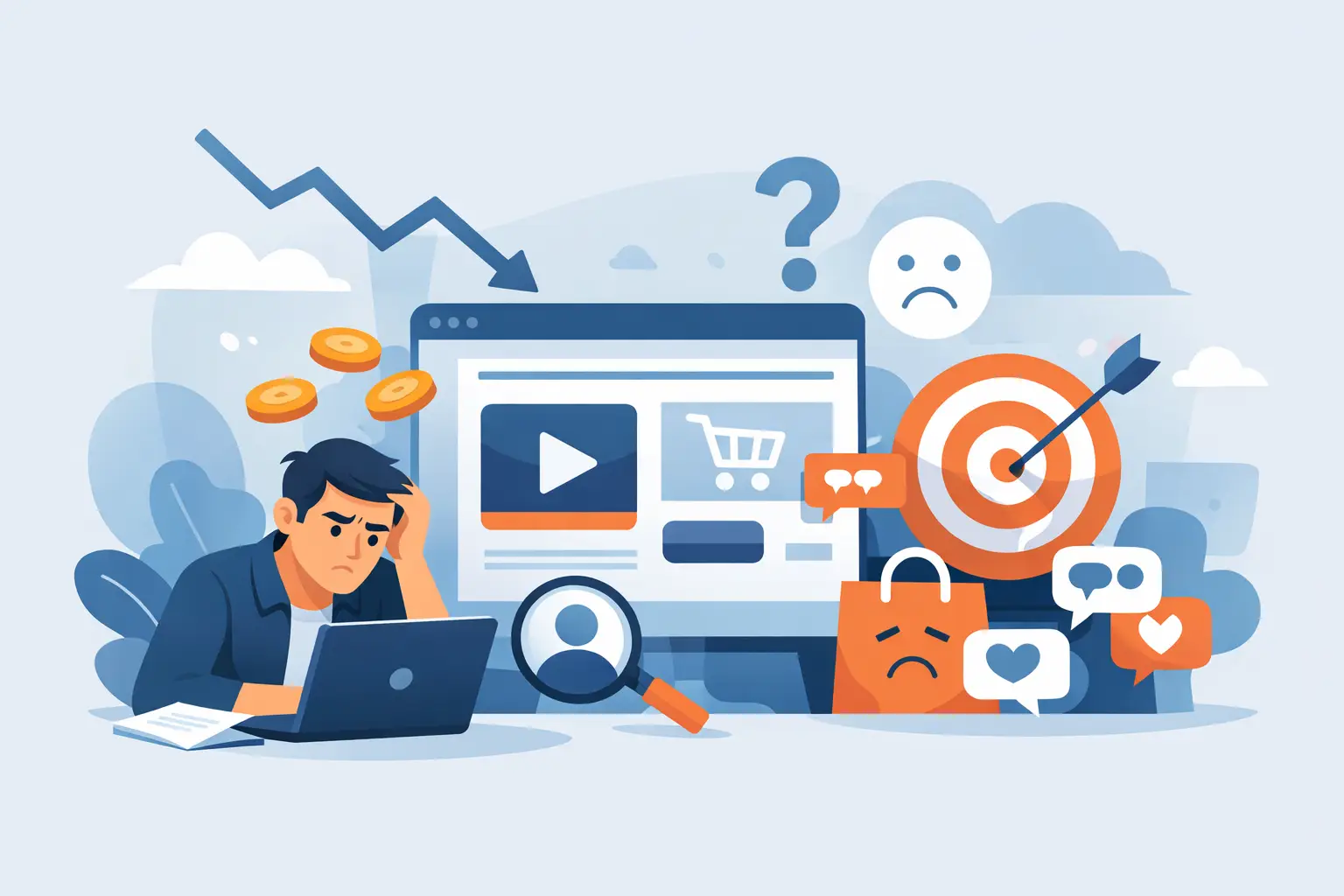
There's a very common scene in many companies: the campaign generates clicks, the budget is consumed, and the report seems to move, but sales don't materialize. When someone wonders why their ads aren't converting, the problem is almost never solely with the ad. Usually, one part of the complete system fails: the offer, the targeting, the landing page, the tracking, or even the subsequent sales process.
That misfocus costs money because it leads to “fixing” the visible while what's truly blocking conversion remains untouched. Changing an image, testing another headline, or increasing the budget might help, but if the proposition doesn't align with user intent or the website hinders progress, the campaign will remain stagnant. Conversion doesn't depend on an isolated piece. It depends on how they all connect.
Why aren't my ads converting even though they're getting clicks?
A click is not a purchase signal. In many cases, it only indicates curiosity, superficial interest, or a mistaken expectation. If the ad promises one thing and the landing page shows another, the user enters and exits. If the targeting is broad, traffic with little intent can arrive. And if the price, terms, or conditions are unclear, friction arises just when the customer was evaluating moving forward.
There are also campaigns on the platform that seem reasonable but are optimized with flawed logic. For example, chasing cheap traffic instead of looking for real opportunities. That approach increases intermediate metrics, but not necessarily revenue. A low cost per click might seem like good news, yet it could be a sign that you are attracting the least valuable audience.
The useful question isn't just how many people clicked. The correct question is what did that user expect to find, what did they actually find, and what prevented them from completing the action.
The problem might be before the announcement.
Many campaigns fail because they try to sell a weak offer with correct execution. If the product isn't differentiated, if the value proposition is generic, or if the market doesn't perceive a clear reason to choose it, the advertisement cannot compensate for that lack of clarity.
This happens a lot in professional services and local businesses. Advertising is launched with messages like “quality,” “trust,” or “personalized attention,” but everyone makes those promises. The user doesn't find a concrete reason to act now. Without a specific benefit, a competitive advantage, or a well-designed offer, the campaign becomes paid noise.
Here it is worth reviewing whether your company is communicating something actionable: speed, savings, specialization, availability, financing, initial diagnosis, demonstration, or a tangible result. It's not about offering discounts for the sake of it. It's about reducing uncertainty and facilitating the decision.
Segmentation: Reaching a lot of people doesn't mean reaching the right ones.
One of the most frequent reasons why my ads don't convert is targeting that mixes audiences that are too different. When that happens, the message loses force because it tries to speak to everyone at once.
A sales manager does not respond the same as a entrepreneur He/She is tearing it up. Nor does someone looking for “price” have the same intention as someone looking for a “specialized supplier.” If profiles, needs, and maturity levels that are different are grouped together in the same campaign, performance is diluted.
In Google Ads, the failure is usually in the keywords poorly chosen, too broad, or with an informational intent. In Meta Ads, the problem arises when relying on generic interests without a clear structure of audiences, creatives, and funnel stages. In both cases, the consequence is similar: you pay for visibility, but not for real intent.
The solution doesn't always lie in segmenting more, but in segmenting better. Sometimes it's advisable to reduce volume to gain quality. Less traffic, but more aligned with the business objective.
The advertisement's message may attract, but not convince
There are ads that grab attention and still sell little. This happens when the text or creative generate clicks out of curiosity but don't filter the right user. An effective ad doesn't just attract. It also pre-selects.
If the message is too broad, it can attract people who would never buy. If it's too technical, it can exclude valid profiles. And if it doesn't connect with a real problem, it will look nice but be irrelevant.
That's why the best copy isn't always the most creative, but the clearest. It needs to quickly answer three things: what it offers, who it's for, and why it deserves attention now. When any of those elements are missing, the campaign loses traction.
Also, consistency between Advertisement and landing page. If the ad talks about a specific solution for lead generation and the page greets the user with generic corporate text, conversion drops. Not because the traffic is bad, but because the experience breaks continuity.
The landing page is where many campaigns get blocked
It's common to blame the ad campaign when the real problem lies with the landing page. A slow, confusing, or irrelevant landing page can sink a well-targeted campaign.
Conversion drops when users don't understand what to do, don't see a clear proposition, or perceive too much friction. Lengthy forms, barely visible calls to action, cluttered design, ambiguous text, or a lack of social proof are quite common mistakes. Sending traffic to the homepage instead of a page designed for a specific intent is also a common issue.
The landing page doesn't need to say everything. It needs to move the user to the next step clearly. If the campaign is seeking leads, the page should make it easy to get in touch. If it's seeking sales, it should eliminate key commercial doubts. Sometimes the most profitable change isn't in the ad, but in simplifying the decision on the website.
If it doesn't measure well, you're optimizing blindly.
Another critical reason is the lack of reliable measurement. Many companies believe their ads aren't converting when in reality they aren't properly tracking conversions. Or vice versa: they believe they are converting because the platform attributes results that don't reflect actual sales.
Without well-configured events, CRM integration, or sales journey tracking, decisions are made with incomplete data. This affects everything: budget, audiences, creative, and expectations.
Not all conversions have the same value. A low-quality lead is not worth the same as a real business opportunity. A 20-second call is not worth the same as a scheduled meeting. Measuring well means differentiating signals of interest from business outcomes.
When advertising, analytics, and business processes are connected, much more useful answers emerge. It's possible to detect which campaigns bring quality leads, which ads only generate volume, and at what exact point opportunities are lost.
The sales team also influences conversion.
This point is often overlooked. There are campaigns that generate enough demand, but the closing fails afterward. If responses are slow, if there's no follow-up, or if the lead reaches the sales team without context, advertising performance appears worse than it actually is.
In businesses with medium or high average ticket prices, conversion doesn't just depend on the platform. It depends on response speed, sales script, contact channel, and follow-up consistency. A campaign can be profitable in lead generation but ineffective in closing due to an operational issue.
That's why the companies that scale best don't see advertising as an isolated channel. They connect it with automation, qualification, and clear sales processes. That's where a 360-degree view, like the one we apply at CLICK Digital, changes the outcome: it's not just the ad that's analyzed, but the entire journey to the sale.
What to review before increasing the budget
When a campaign doesn't convert, increasing investment rarely fixes the problem. It usually just speeds up spending. It's better to first review five fronts: traffic intent, offer clarity, consistency between ad and landing page, measurement quality, and sales responsiveness.
If one of those points is broken, the campaign doesn't need more budget. It needs more precision. Sometimes the right adjustment is to change the promise. Other times, it's to exclude audiences, redo the landing page, or redefine what's considered a valid conversion.
It's also worth accepting that not every problem has a single cause. There might be a combination of unqualified clicks, a weak proposal, and slow follow-up. In those cases, optimizing only one element makes little improvement. The real leap forward comes when the entire system is corrected.
The good news is that almost no campaign is doomed by definition. When diagnosed with discernment, clear opportunities for improvement usually emerge. And that's the difference between managing ads and managing growth: not just looking at the platform, but understanding everything that happens between the impression and the sale.
If your ads aren't converting, don't immediately assume the channel isn't working. Sometimes the market does respond, but the funnel isn't set up to capture that intent. That's where real improvement begins.
