
Blog
Digital Marketing Trends 2026 Key

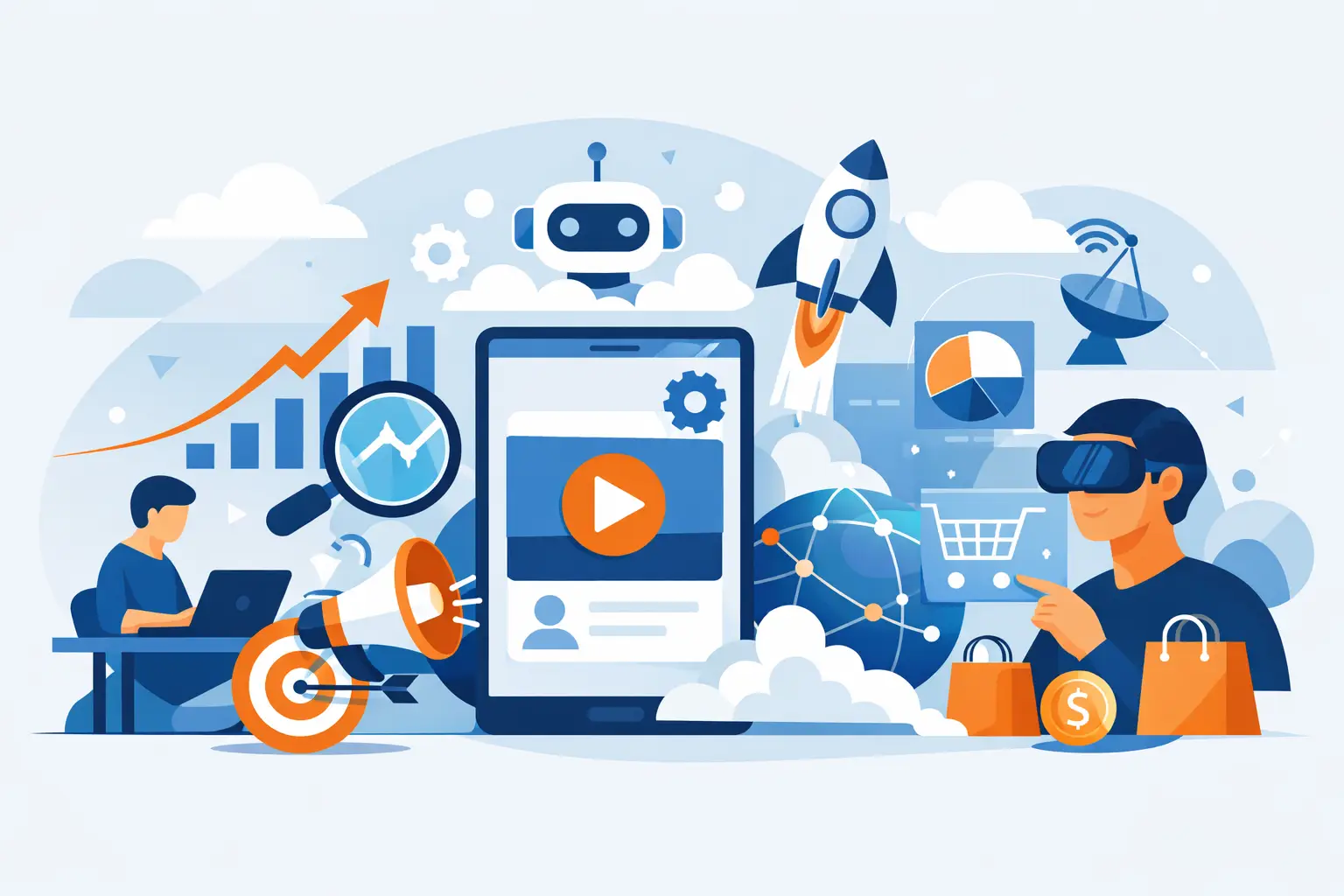
If your company continues to measure marketing solely by clicks, impressions, or followers, 2026 will demand much more from you. Digital marketing trends for 2026 point to a clear shift: fewer isolated actions and more connected systems to attract demand, convert better, and operate more efficiently. It's no longer about who publishes more. It's about who integrates strategy, data, automation, and customer experience.
For many companies, especially SMEs and growing brands, the challenge won't be “being digital,” but rather stop working through disconnected channels. Having active social media, Meta campaigns, or a renovated website helps, but it's not enough if each piece operates independently. What's coming for 2026 rewards coordination between SEO, advertising, content, CRM, automation, and artificial intelligence applied to the business.
What truly changes in digital marketing trends in 2026
For years, much of the market separated marketing into tasks: one agency for ads, another for design, someone in-house for social media, and a different vendor for the web. That approach is starting to fall short. In 2026, pressure for profitability will cause companies to demand complete traceability: where the lead came from, how much it cost, which channel closed the sale, and which process can be automated to reduce sales time.
That changes the conversation. Marketing ceases to be a difficult-to-justify cost center and becomes a measurable system for acquisition and growth. But there's an important nuance: not every trend works the same for everyone. A clinic, an e-commerce business, a B2B company, or a local brand don't compete under the same rules. The advantage isn't in adopting everything, but in applying what generates real impact according to the business model.
Applied AI, but with a focus on results
Artificial intelligence will continue to grow, but by 2026 it will no longer impress on its own. What will be relevant is its ability to solve concrete problems. Creating texts in seconds or generating images will no longer be a differentiator if the content doesn't convert, if the chatbot doesn't qualify leads, or if automation doesn't save the team time.
The strong trend will be operational AI. We're talking about agents that answer frequently asked questions, Sales assistants that filter opportunities, systems that nurture leads based on behavior, and flows that connect forms, ads, CRM, and tracking. The right question won't be “Does it use AI?”, but rather “What part of the process does it improve and how much return does it produce?”.
Here, it's worth avoiding a common mistake: automating a flawed process only speeds up the problem. Before implementing AI, it's necessary to streamline the business proposal, conversion funnels, and messaging by stage. When that foundation exists, technology multiplies results. When it doesn't, it just adds noise.
Less mass content, more useful content trained with intention
In 2026, there will be even more AI-generated content, and precisely because of this, generic content will lose its strength. Users quickly detect when a brand repeats empty formulas. Google has also refined its ability to prioritize pieces that respond well to a real search intent.
The opportunity will be in producing content with commercial criteria. This means working on topics aligned with purchase questions, frequent objections, comparisons, concrete uses, and local or sectoral searches. An article, a landing page, or an email sequence should respond to a phase of the sales process, not just fill the editorial calendar.
More strategic SEO and less volume-based
SEO is not disappearing. It's becoming more demanding. Among the main digital marketing trends for 2026, one of the most relevant will be the shift from SEO focused on single keywords to an approach of subject matter expertise, User experience and conversion.
This implies faster websites, better-thought-out structures, interconnected content, and pages oriented towards transactional intent. It also demands that the website stops being a digital brochure. If the site doesn't load well, doesn't answer the user's query, or lacks a clear value proposition, organic traffic loses value even if visits increase.
Furthermore, search will continue to fragment. There will be users arriving from Google, others from internal search engines on social media, others from AI-generated answers, and others from marketplaces or maps. This is why visibility is no longer won on a single front. Your brand needs technical, semantic, and commercial consistency across all the places it can be discovered.
Local search gains weight in businesses that rely on trust
For service companies, clinics, offices, construction firms, gyms, or businesses with geographic coverage, local positioning will remain decisive. It's not enough to just show up. You need to convey credibility instantly. Reviews, optimized listings, service-specific pages, mobile speed, and locally-focused content will make a difference.
In increasingly competitive markets, pre-call or pre-form trust will be a conversion factor as important as advertising budget.
Digital advertising with more control and less waste
The trend in Google Ads and Meta Ads will continue to be a strong acquisition driver, but 2026 will demand campaigns more closely connected to the business. It will no longer be enough to optimize for cheap clicks or form volume. The most competitive companies will measure lead quality, closing rate, cost per actual opportunity, and return per channel.
This forces an improvement in the relationship between marketing and sales. If the sales team doesn't provide feedback, the campaign is optimized blindly. If there's no follow-up, many valid leads go cold. And if the offer isn't well-structured, even the best ad can't save a poor conversion.
We will also see more creative content tailored to different funnel stages. Cold outreach messages, social proof for warm audiences, and closing-oriented ads for those who have already interacted with the brand. Automatic segmentation will continue to grow, yes, but strategic judgment will remain human.
Commercial automation as a competitive advantage
One of the most profitable trends for 2026 will be the automation of business and customer service processes. Not because it completely replaces the team, but because it eliminates downtime. Responding late, missing inquiries on WhatsApp, not following up, or sending proposals with delays continues to cost sales every day.
Automation does not mean dehumanization. It means ensuring that every lead receives an adequate response, that every opportunity is followed up on, and that the human team steps in where they add the most value. In many businesses, this combination improves conversion without needing to double advertising investment.
A well-designed system can classify contacts, assign priorities, activate email or message sequences, schedule meetings, and feed reports. The benefit is not just operational. It also improves the customer experience and gives management a clearer view of what's working.
Social networks with less improvisation and more commercial function
Networks will remain relevant, but it will become increasingly clear which brands post out of habit and which use them as a business channel. In 2026, the social content that will perform best will be that which fulfills a specific function: educating, building trust, addressing objections, showing results, or activating demand.
This reduces the value of decorative content. It's not about posting for the sake of posting or chasing every viral trend. For a company, the useful question is different: does this format bring the user closer to a decision or just take up space?
Short videos, testimonials, demonstrations, comparisons, and consultative-focused pieces will continue to gain weight. But again, it depends on the industry. A consumer brand can thrive more on reach and community. A B2B business or one selling complex services will need content that streamlines decision-making and reduces friction.
Websites designed to convert, not just to look good
In 2026, a Beautiful website but slow, confusing, or poorly structured will be a commercial disadvantage. The standard is rising. Users expect immediate clarity, simple navigation, trust signals, mobile adaptation, and visible calls to action.
The ideal website isn't the one with the most visual effects, but rather the one that helps sell better. This includes well-defined service pages, useful forms, integration with analytics, connection with CRM, content that supports SEO, and an architecture that guides the user from initial doubt to contact.
For many companies, here's one of the biggest drains on profitability. They invest in ads or networks but send the traffic to a site that doesn't convert. Fixing that usually yields quicker results than opening a new channel.
What should companies aiming to be strong in 2026 do today?
The best move isn't to chase every new trend, but to build a solid foundation. This involves reviewing if your digital strategy connects visibility, acquisition, follow-up, and closing. If any of those pieces fail, growth will slow down even if the rest are working reasonably well.
It's also worth prioritizing. Some companies will need to strengthen SEO and their website. Others should organize their ad campaigns and better measure their return. Others are already ready to incorporate automation or AI agents. The right decision depends on where the real bottleneck is.
From that perspective, working with an integrated approach ceases to be a luxury and becomes a practical advantage. When strategy, content, advertising, development, automation, and analytics are coordinated, marketing stops feeling scattered and begins to behave like a growth system. That is precisely the area where an agency like CLICK Digital can generate more value.
2026 will not reward brands that make the most noise, but those that best convert every visit, every lead, and every process. If your company wants to grow with more control, now is a good time to stop accumulating scattered actions and start building a digital operation that truly sells.
